Vendor onboarding automation is where operations, procurement, finance, risk, and IT discover they have been running five different processes with one shared name.
One team wants a cleaner supplier intake form. Another wants tax and bank details validated before AP touches them. Procurement wants requesters to stop bypassing policy. Risk needs questionnaires and sanctions review. The ERP owner wants vendor master data that does not create duplicates, bad payments, or audit headaches.
That is why partner selection matters. A vendor onboarding automation partner is not just someone who can configure a form. The right partner can make the workflow safer, faster, and easier to own after launch.
Short answer
The best vendor onboarding automation partner depends on the control problem. Red Brick Labs is the best fit when operations needs a focused workflow-first implementation across existing tools. Coupa, SAP Ariba, and Ivalua implementation partners fit source-to-pay platform rollouts. Deloitte, Accenture, KPMG, and GEP-style procurement transformation firms fit large operating-model redesigns. PaymentWorks, Graphite Connect, Certa, Tipalti, Routable, and Zip professional services or ecosystem partners fit platform-led onboarding, supplier risk, payables, or procurement orchestration projects.
If you are still comparing software, start with the vendor onboarding automation tools comparison. If the workflow requirements are still fuzzy, use the vendor onboarding automation requirements template before taking demos. Then model the business case with the vendor onboarding automation ROI worksheet and pressure-test agent permissions with the AI agent governance checklist.
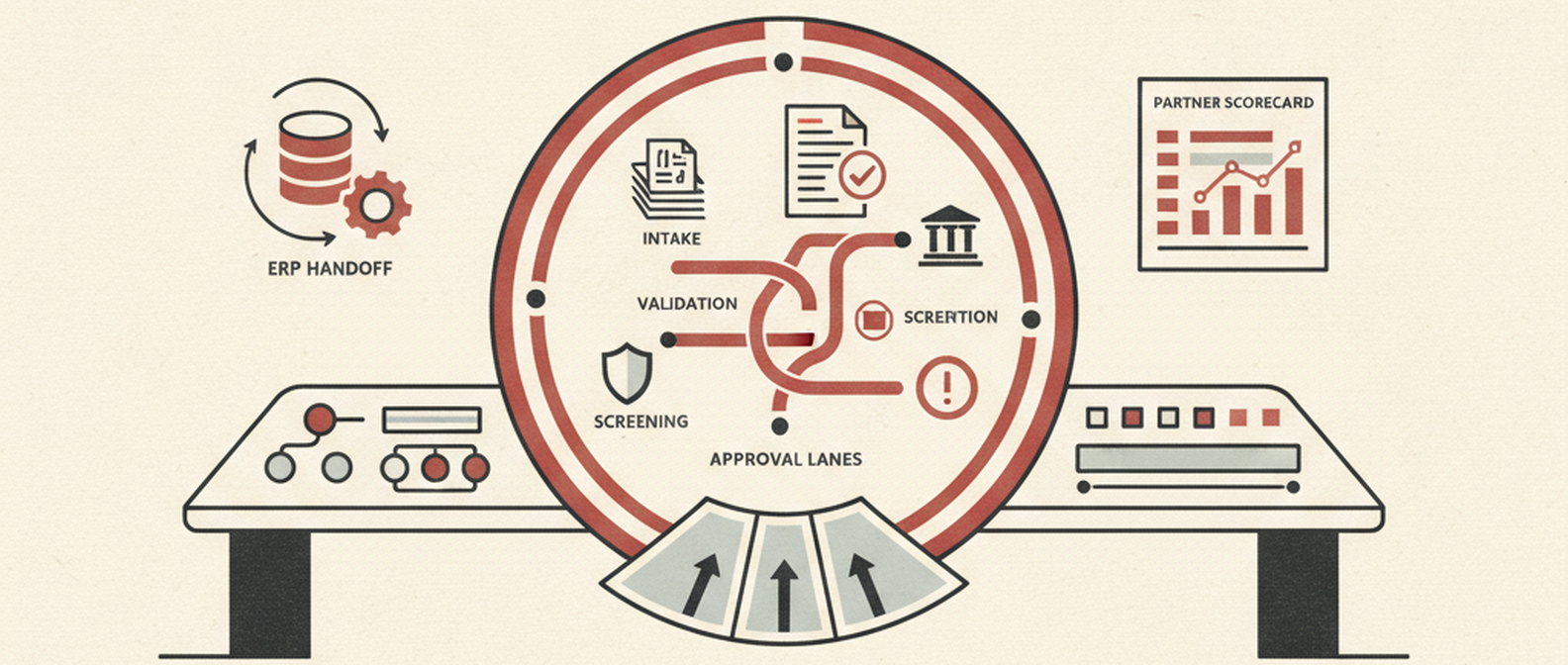
*Visual requirement: create a slug-specific hero image showing a vendor onboarding control room with supplier intake, tax documents, bank validation, sanctions/risk screening, approval lanes, ERP handoff, and a partner scorecard. Add a supporting comparison-table graphic at /blog/images/best-vendor-onboarding-automation-partners-for-operations-teams-comparison-table.png. Capture later public screenshots for the named partner ecosystems and platform pages if this article is expanded into a visual teardown.*
Vendor onboarding automation partner comparison table
Use this table before taking sales calls. The right answer changes depending on whether the project is a narrow workflow build, a platform rollout, a risk program, a payables workflow, or a broad procurement transformation.
| Partner model | Best fit | Strengths | Watch-outs | First deliverable |
|---|---|---|---|---|
| Workflow-first AI automation partner | Mid-market operations teams with messy handoffs across email, procurement, AP, risk, ERP, and spreadsheets | Current-state mapping, custom workflow, AI-assisted extraction and routing, human review, integration into existing stack, fast pilot | Needs strong internal owner and narrow scope for version one | Vendor onboarding workflow map, control plan, exception taxonomy, integration plan, pilot backlog |
| Source-to-pay implementation partner | Teams already choosing Coupa, SAP Ariba, Ivalua, GEP, Jaggaer, Oracle, or another procurement suite | Platform configuration, supplier lifecycle design, procurement process knowledge, change management, certified implementation resources | Can overfit the process to the platform and under-scope work outside procurement | Platform design workbook, supplier lifecycle configuration, integration and UAT plan |
| Enterprise procurement transformation firm | Large organizations redesigning procurement operations, shared services, supplier management, risk, and operating model | Governance, operating model, process standardization, global rollout, transformation management | Too broad or slow for one urgent vendor setup workflow | Procurement operating model, roadmap, business case, governance plan |
| Supplier onboarding or supplier information specialist | Teams where the bottleneck is supplier data collection, validation, supplier self-service, and vendor master quality | Supplier registration, tax/bank validation, supplier-managed profiles, duplicate reduction, ERP handoff | May not solve procurement intake, contract approval, category review, or broader AP workflow | Supplier data requirements, validation rules, ERP field map, approval path |
| Third-party risk and compliance partner | Regulated teams where onboarding is slowed by risk questionnaires, screening, due diligence, remediation, and ongoing monitoring | TPRM workflow, risk scoring, due diligence, approvals, audit evidence, continuous monitoring | Overpowered for basic vendor setup if risk is not the real bottleneck | Risk tiering model, questionnaire flow, screening rules, remediation path |
| AP, payout, or payables implementation partner | Finance teams where onboarding is tied to payee setup, tax forms, payments, and supplier payment operations | Supplier/payee onboarding, tax document collection, payment methods, ERP/accounting sync, payment controls | Procurement and risk workflows may live elsewhere | Payee onboarding plan, tax/payment control map, ERP/accounting sync design |
| Procurement intake and orchestration partner | Teams where new vendor requests start in Slack, email, forms, or tickets before procurement can triage them | Single front door, dynamic routing, cross-functional approvals, AI prefill, orchestration across finance/legal/security | Usually not the final vendor master, risk system, or AP platform | Intake model, approval lanes, downstream handoff plan, requester experience design |
| Internal operations or IT team with specialist advisor | Teams with strong system ownership and available builder capacity | Maximum control, institutional knowledge, lower vendor dependency | Often stalls when requirements, controls, or integrations are unclear | Architecture review, requirements review, control checklist, implementation support plan |
The mistake is treating these partner models as interchangeable. A Coupa partner, a TPRM consultant, a payout platform services team, and a workflow-first AI automation partner can all help with "vendor onboarding." They do not solve the same failure mode.
What a vendor onboarding automation partner actually does
A useful partner should turn vendor onboarding into a controlled operating workflow.
That means the partner should help your team answer:
- Where does a new vendor request start?
- Which supplier documents are required by entity, country, payment method, and risk tier?
- Who validates tax data, banking details, sanctions results, duplicate matches, insurance, certificates, and questionnaires?
- Which approvals are required before the vendor can be created, changed, activated, or paid?
- What should the automation do when supplier data does not validate?
- Which system is the source of truth: procurement platform, supplier information system, AP platform, ERP, risk platform, or custom workflow database?
- What can AI extract, summarize, prefill, classify, or route?
- What should never be auto-approved in version one?
- Who owns the workflow after launch?
If a partner cannot talk about exception handling, payment controls, and ERP write permissions, they are not ready for vendor onboarding. They may be ready for a form.
Best overall for focused vendor onboarding pilots: Red Brick Labs
Red Brick Labs fits the workflow-first implementation lane: vendor onboarding automation for teams that need production progress without replacing the whole stack.
This is the right lane when vendor onboarding spans several systems:
| Workflow layer | Practical first version |
|---|---|
| Intake | One requester form, procurement inbox, vendor request queue, or Slack/Teams trigger |
| Supplier record | Structured record with requester, entity, vendor type, tax status, payment method, documents, risk tier, and system IDs |
| AI role | Extract fields, classify vendor type, summarize missing data, draft reviewer notes, suggest routing |
| Validation | Required documents, duplicate check, TIN or tax review, bank-detail review, sanctions or exclusion screening, certificate checks |
| Human review | Named approval gates for risk, payment details, ERP creation, high-value vendors, and exceptions |
| Exception queue | Missing documents, low-confidence extraction, duplicate risk, payment mismatch, sanctions hit, unsupported vendor type |
| ERP handoff | Staged record, reviewed export, API sync, or finance-controlled vendor creation path |
| Controls | Segregation of duties, audit log, approval evidence, rollback plan, least-privilege access |
| Metrics | Cycle time, first-pass completion, exception rate, manual touches, approval aging, vendor data defect rate |
The Red Brick Labs POV is simple: do not automate vendor onboarding until you can separate collection, validation, approval, and writeback.
AI can read documents, prefill fields, summarize missing requirements, and route cases. It should not silently approve a supplier, clear a sanctions match, change bank details, or create an ERP vendor without named controls.
Choose a workflow-first partner when:
- vendor onboarding spans procurement, finance, risk, legal, security, and ERP ownership;
- the current process lives in email, forms, spreadsheets, ticketing systems, and tribal knowledge;
- the team has not chosen a platform yet;
- the existing platform cannot express the full exception path;
- the first useful workflow needs to ship in weeks, not after a global procurement transformation.
This is also where the existing tools article should stay in its lane. The vendor onboarding automation tools comparison helps choose software categories. This article is about who can implement the operating system around that choice.
Best for source-to-pay platform rollouts: Coupa, SAP Ariba, Ivalua, and similar implementation partners
If the organization has already decided that vendor onboarding belongs inside a source-to-pay suite, the best partner is often a certified or deeply experienced implementation partner for that platform.
Coupa publicly describes a consulting, implementation, and advisory partner ecosystem for services, customizations, and guidance. Ivalua describes a partner-first strategy and a large certified partner community. SAP Ariba Supplier Lifecycle and Performance positions supplier lifecycle management around onboarding, supplier self-service, questionnaires, qualification, compliance, and integration with SAP Ariba solutions.
That partner model fits when:
- procurement is standardizing source-to-pay;
- supplier onboarding must connect to sourcing, contracts, POs, invoices, supplier performance, and spend visibility;
- the enterprise already runs Coupa, SAP Ariba, Ivalua, GEP, Jaggaer, Oracle, or another procurement suite;
- user adoption, configuration, supplier portals, and ERP integration are part of the implementation.
Watch-out:
Platform partners are strongest after platform direction is clear. If the buying team has not defined the intake model, validation rules, approval authority, vendor master ownership, and exception path, a platform-first rollout can hard-code a bad process.
Best for enterprise procurement transformation: Deloitte, Accenture, KPMG, GEP-style firms
Large procurement transformations are a different species from a focused vendor onboarding workflow.
Deloitte's sourcing and procurement materials cover procurement diagnostics, operating model design, governance, digital procurement, technology assessment, implementation, integration, process automation, supplier lifecycle management, and supply risk management. Accenture describes source-to-pay, source-to-contract, procure-to-pay, and strategy-to-operate services, with emphasis on data-powered procurement, control, risk, efficiency, and long-term transformation. KPMG Powered Procurement talks about broken legacy processes, cloud technology, automation, predictive analytics, cognitive learning, and enabled platforms including Coupa, Ivalua, and SAP. GEP positions procurement transformation around AI-driven consulting, operating model change, and source-to-pay improvement.
Shortlist this category when:
- vendor onboarding is one part of a global procurement operating model redesign;
- shared services, supplier management, responsible sourcing, third-party risk, and ERP modernization are in scope;
- leadership needs a business case, governance model, change program, and transformation office;
- the rollout spans countries, business units, categories, and policy redesign.
Watch-out:
This category can be expensive and slow for a narrow operations pain. If the urgent problem is "new vendors take too long and AP is manually checking every file," start with a scoped workflow audit before launching a broad transformation program.
Best for supplier data and vendor master controls: PaymentWorks and Graphite Connect ecosystem help
PaymentWorks and Graphite Connect are useful when vendor onboarding is mostly a supplier data quality and payment-control problem.
PaymentWorks' public vendor onboarding materials emphasize secure supplier onboarding, compliance, fraud risk, integration with financial systems, approval workflows, and audit trails. Graphite Connect's supplier onboarding page highlights automated validation of tax ID, banking information, and sanctions checks, with repeat sanctions checks and validation when supplier data changes.
This partner lane fits when:
- suppliers submit incomplete or risky information;
- finance is worried about bank-detail changes, duplicates, W-9/W-8 quality, and vendor master defects;
- the ERP vendor record is the sensitive boundary;
- supplier self-service and validation matter more than broad procurement transformation.
Watch-out:
Supplier onboarding specialists do not automatically replace procurement intake, sourcing approvals, contract workflows, or AP payment execution. Ask exactly where the supplier record is created, who approves exceptions, and how changes sync back to ERP.
Best for third-party risk-heavy onboarding: Certa and TPRM implementation partners
Certa fits when vendor onboarding is really third-party risk onboarding.
Certa's public materials position the product around third-party lifecycle management, onboarding, screening, due diligence, approvals, continuous monitoring, and compliance. That is the right frame when a new vendor cannot be approved until risk, legal, security, privacy, ESG, resilience, or compliance work is complete.
Shortlist this partner model when:
- supplier onboarding requires risk tiering before approval;
- due diligence questionnaires and remediation tasks drive cycle time;
- regulated teams need audit-ready evidence;
- vendor monitoring continues after initial onboarding;
- procurement, legal, security, privacy, and compliance all need a say.
Watch-out:
Do not buy a full TPRM operating model when the real problem is AP data collection. Conversely, do not force third-party risk into a basic vendor setup form when the business needs risk governance.
Best for AP, payee, and payout-heavy onboarding: Tipalti, Routable, and payables implementation partners
Some teams call it vendor onboarding, but the real workflow is payee setup.
Tipalti's supplier management materials describe supplier lifecycle management, supplier data across AP and procurement, ERP data sync, onboarding portal experience, and supplier hub capabilities. Routable's vendor onboarding materials emphasize automated W-9/W-8 collection, payment setup, compliance checks, centralized vendor information, accounting sync, and API-driven workflows.
This partner lane fits when:
- suppliers, contractors, creators, affiliates, or partners need to get paid at scale;
- tax forms, payment methods, compliance checks, and accounting sync are the main work;
- AP owns the process more than procurement;
- vendor experience and payout readiness are the biggest bottlenecks.
Watch-out:
Payables partners are not automatically procurement partners. If sourcing approval, contract review, risk tiering, or supplier performance are upstream requirements, design those handoffs before payee setup becomes the only system of record.
Best for procurement intake and orchestration: Zip-style implementation support
Zip belongs in the conversation when the pain starts before vendor onboarding.
Zip currently positions itself as an AI procurement platform that orchestrates intake-to-pay, with products for intake-to-procure, procure-to-pay, supplier onboarding, sourcing, risk orchestration, contract orchestration, workflow engine, integrations, and AI procurement concierge capabilities.
That makes orchestration useful when:
- requests arrive through email, Slack, spreadsheets, or tickets;
- employees do not know the right procurement path;
- finance, legal, IT, security, and procurement need dynamic approvals;
- vendor setup should happen only after a clean request and policy path;
- the organization needs a procurement front door before downstream systems take over.
Watch-out:
An intake layer is not the whole control model. The downstream source of truth still matters: supplier profile, vendor master, AP platform, risk platform, and ERP. Ask how data moves after approval and who owns failed syncs.
Specific evaluation criteria for partner selection
Do not compare partners by logos. Compare them by evidence.
| Criterion | Weight | What weak looks like | What strong looks like |
|---|---|---|---|
| Workflow diagnosis | 5x | Starts with a demo or generic "supplier journey" map | Maps requester intake, supplier submission, validation, approvals, exceptions, ERP handoff, and payment boundary |
| Control design | 5x | Treats faster onboarding as the only goal | Separates collection, validation, approval, writeback, and payment readiness |
| Supplier data validation | 5x | Says "we validate vendor data" without specifics | Defines required documents, duplicate logic, tax review, bank-detail controls, sanctions/exclusion screening, and owner by exception type |
| ERP and accounting fit | 5x | Mentions connector logos | Shows field map, source-of-truth rules, write permissions, retry behavior, reconciliation, and rollback |
| Risk and compliance handling | 4x | Sends risk review to email | Defines risk tiers, questionnaires, due diligence, remediation, approval evidence, and monitoring |
| AI boundaries | 4x | Promises straight-through onboarding immediately | Defines what AI may extract, classify, summarize, suggest, route, and never approve |
| Implementation speed | 3x | Cannot name a version-one scope | Can ship a narrow pilot with clear exclusions, test cases, and measurable cycle-time goals |
| Change management | 3x | Assumes suppliers and requesters will comply | Designs requester experience, supplier instructions, approver training, and adoption reporting |
| Ownership transfer | 4x | Keeps rules opaque inside the partner's account | Leaves documentation, admin training, monitoring, runbooks, and change process |
| Commercial fit | 3x | Sells a transformation when you need a pilot | Matches scope, timeline, budget, and internal capacity to the actual workflow risk |
The highest-scoring partner is not always the most famous one. It is the one that can prove it understands your control environment.
Questions to ask every finalist
Ask these before you let anyone propose the solution.
- Which vendor onboarding failure mode do you think we have: intake, data validation, approvals, risk review, AP setup, ERP writeback, supplier experience, or ownership?
- What should version one not automate?
- How will you handle a duplicate vendor match?
- How will you handle a bank-detail mismatch or payment-detail change?
- Who can approve vendor creation, vendor activation, and payment readiness?
- Where will exceptions live, and who owns them?
- Which system is the source of truth for supplier profile data?
- What fields will be written to the ERP, and under what approval conditions?
- What audit evidence will exist after each approval?
- What will our team be able to change without calling you?
If a partner cannot answer these without hiding behind "best practices," keep looking.
Red Brick Labs POV
Vendor onboarding automation should start as a control upgrade, not a speed project.
The first version should collect supplier information, validate the riskiest fields, route exceptions, prepare an ERP-ready record, preserve approval evidence, and give operations one queue to manage. Only after that should the workflow expand into more automated writebacks, AI-assisted decisions, and downstream payment actions.
Red Brick Labs would start with a two-week vendor onboarding workflow audit:
- Sample recent vendor onboarding cases.
- Map intake, supplier submission, validation, approvals, risk review, ERP creation, and payment readiness.
- Identify the top five exception types.
- Define the first safe automation boundary.
- Build a pilot around the highest-volume, lowest-risk vendor segment.
That keeps the project grounded. The goal is not to buy the most impressive supplier management acronym. The goal is fewer manual touches, cleaner vendor records, safer payments, and a workflow the team can operate.
CTA: audit the workflow before choosing a partner
If vendor onboarding still depends on inbox chasing, duplicate spreadsheets, one-off approvals, and manual vendor master cleanup, Red Brick Labs can help you design the first production workflow.
Book a 15-minute vendor onboarding automation consult and we will help you decide whether you need a platform partner, a procurement transformation firm, a payables specialist, or a focused automation build.
Audit your vendor onboarding workflow: Red Brick Labs can map your current vendor onboarding flow, separate software needs from implementation needs, design tax and bank-detail controls, and build the first production workflow around your existing procurement, AP, risk, and ERP systems.
Source notes
- Red Brick Labs' existing vendor onboarding automation tools comparison covers software categories. This article intentionally covers partner models and implementation responsibility.
- Coupa's public partner page supports the platform-implementation lane: Coupa describes a consulting, implementation, and advisory partner network for services, customizations, and guidance.
- Ivalua's partner ecosystem page supports the source-to-pay implementation lane: Ivalua describes a partner-first strategy and a large certified community of consultants and partners.
- SAP Ariba Supplier Lifecycle and Performance supports the enterprise supplier lifecycle lane: SAP describes supplier onboarding, self-service entry, questionnaires, qualification, compliance, and integration with SAP Ariba solutions.
- Deloitte, Accenture, KPMG, and GEP sources support the enterprise procurement transformation lane: their public pages frame procurement work around operating model design, source-to-pay, procure-to-pay, digital procurement, automation, governance, change management, and AI-enabled procurement.
- PaymentWorks and Graphite Connect sources support the supplier data and payment-control lane: their public pages emphasize supplier/vendor onboarding, tax and bank validation, fraud or compliance controls, approval workflows, audit evidence, and ERP/financial-system handoff.
- Certa supports the TPRM lane: its public page positions the platform around third-party lifecycle management, onboarding, screening, due diligence, approval, compliance, and monitoring.
- Tipalti and Routable support the AP/payee lane: public pages describe supplier/payee onboarding, tax forms, payment setup, ERP or accounting sync, compliance checks, and payment operations.
- Zip supports the procurement orchestration lane: its public site positions Zip around intake-to-pay, supplier onboarding, workflow engine, risk orchestration, integrations, and AI procurement orchestration.