Growing finance teams usually do not have an invoice problem. They have a control problem disguised as an invoice problem.
The PDFs are in email. The PO is in one system. The approval rule is in someone's head. The vendor master is stale. The controller does not trust the extracted fields. The accounting team still has to clean up the bill before close. Then somebody says, "Let's automate AP," as if the mess will politely organize itself because a vendor demo had blue checkmarks.
This guide compares the best categories of invoice automation consultants for finance teams that are growing past spreadsheet AP but are not ready to spend a year inside a finance transformation program.
Short answer
The best invoice automation consultant for a growing finance team is a hands-on implementation partner that can map invoice intake, extraction, validation, approvals, exceptions, and accounting handoff before selecting or configuring tools. Big consultancies fit broader finance transformation and managed services work. ERP and AP software partners fit platform-specific rollouts. Specialist automation partners fit teams that need a controlled invoice workflow shipped quickly inside the existing stack.
For most growing finance teams, choose the consultant who can prove six things: AP workflow depth, finance controls, ERP integration, exception handling, pilot discipline, and ownership transfer. If they start with software before they understand your invoice failure modes, keep shopping.
Start with the invoice OCR vendor evaluation scorecard if you are comparing tools. Use the invoice OCR implementation checklist before any automation touches accounting records. If your immediate pain is exception review, read the guide to using Google Sheets and ChatGPT to triage invoice exceptions.
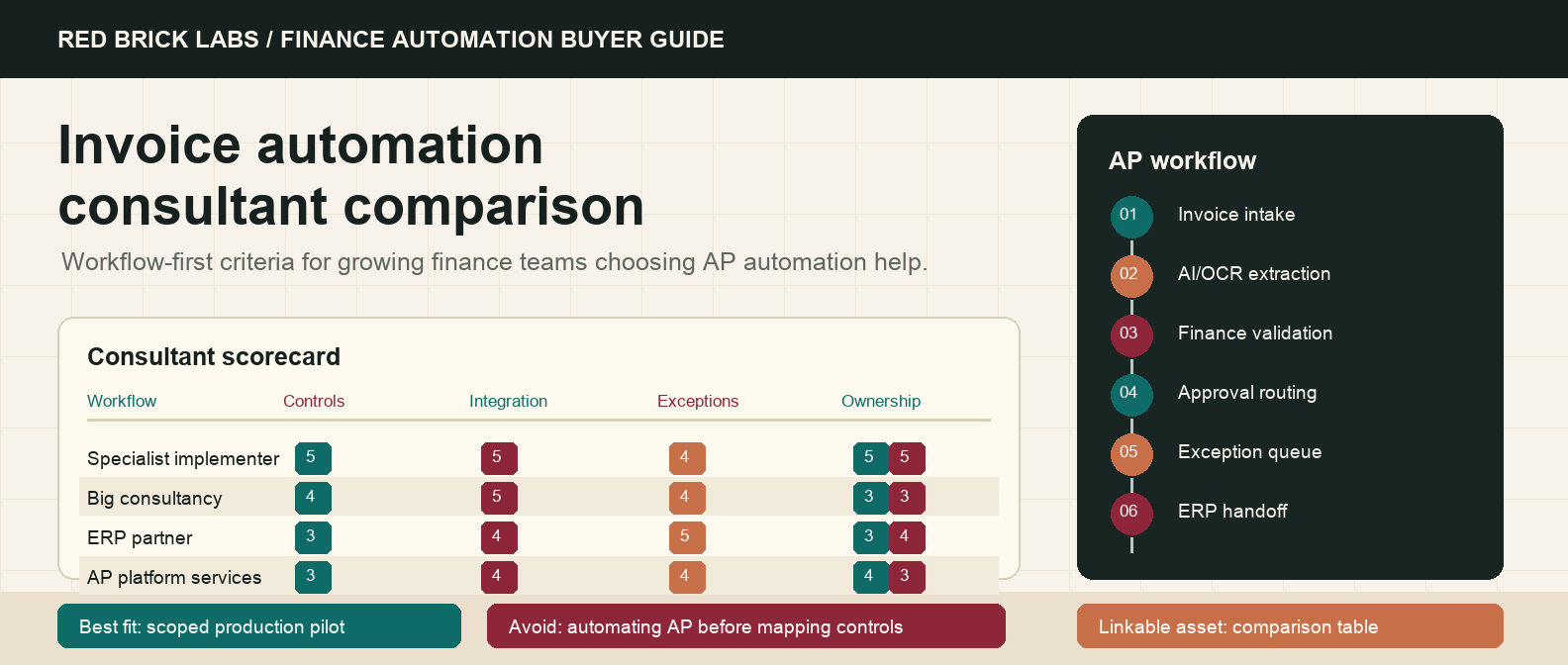
*Compare invoice automation consultants by workflow depth, AP controls, exception handling, ERP handoff, and ownership after launch.*
Invoice automation consultant comparison table
Use this as the first-pass filter before taking sales calls.
| Consultant category | Best fit | Strengths | Watch-outs | What they should deliver first |
|---|---|---|---|---|
| Specialist AI automation implementation partner | Growing teams with messy invoice workflows and limited internal build capacity | Workflow mapping, OCR/AI layer, approval routing, integrations, exception queues, fast pilot delivery | Quality varies; inspect real implementation depth | Current-state AP map, pilot scope, controls, integration plan, working prototype |
| Finance transformation consultancy | Mid-market or enterprise finance teams redesigning AP as part of broader operating model change | Finance process maturity, controls, shared services, governance, change management | Can be too slow or broad for one invoice workflow | AP maturity assessment, transformation roadmap, control model |
| Big Four AP automation teams | Larger companies that need procurement comfort, global operating model alignment, and risk governance | Brand trust, finance transformation experience, managed services, technology ecosystem access | Scope and cost can outrun a simple invoice automation need | AP automation assessment, target operating model, business case |
| ERP implementation partner | Teams standardizing on NetSuite, Dynamics, SAP, Oracle, QuickBooks, Xero, or Sage | Deep platform configuration and accounting-system integration | May force workflow into platform defaults | ERP field map, approval configuration, integration design, test plan |
| AP automation software professional services | Teams that already chose a platform | Product expertise, implementation templates, direct support paths | Platform-first bias; weaker vendor-neutral advice | Platform rollout plan, configuration workbook, migration and testing plan |
| Microsoft Power Platform consultant | Finance teams already living in Microsoft 365, Teams, SharePoint, Dataverse, or Dynamics | Power Automate approvals, AI Builder extraction, Teams approvals, Dataverse workflows | Can become brittle if rules stay buried in flows | Invoice record model, approval matrix, Power Automate pilot, exception queue |
| Outsourced AP provider with automation | Teams that need process capacity plus tooling | Takes work off the finance team, can standardize invoice handling | Less internal ownership; automation may be opaque | Service design, controls matrix, reporting cadence, handoff model |
| Internal build team plus advisor | Technical teams with engineering capacity and finance ownership | Maximum control, custom workflow fit, no vendor lock-in | Slow if finance requirements are unclear or engineers lack AP context | Architecture review, requirements, controls, build plan, evaluation criteria |
The category matters more than the logo. A famous consultancy is a bad choice for a narrow four-week pilot if the project only needs invoice intake, validation, approval routing, and accounting sync. A lightweight automation shop is a bad choice if the invoice workflow crosses entities, tax rules, procurement policy, audit requirements, and ERP governance.
Best overall for growing teams: specialist invoice automation implementation partner
For a growing finance team, the strongest fit is usually a specialist implementation partner that can own the messy middle between finance policy and working automation.
That partner should be able to:
- Map every invoice source: shared inbox, vendor portal, procurement system, uploaded PDF, email attachment, scanned document, or internal request.
- Define the invoice record before building automations.
- Choose the right extraction approach: AP suite, OCR product, intelligent document processing platform, AI Builder, cloud OCR API, or custom model workflow.
- Add validation rules for vendor, PO, amount, tax, currency, duplicate risk, bank-detail changes, and extraction confidence.
- Route approvals by amount, department, entity, cost center, project, PO status, and risk.
- Create an exception queue finance can actually work.
- Integrate approved data into the accounting or ERP system.
- Train finance and operations to maintain rules after launch.
This is where Red Brick Labs fits. The Red Brick Labs POV is simple: do not buy invoice automation until you know which part of the AP workflow you want automated and which part must stay human-controlled. For growing teams, the first build should be narrow, measurable, and production-grade.
A good first pilot is not "automate all AP." That is consultant bait. A good first pilot is:
| Pilot component | Practical version |
|---|---|
| Invoice source | One shared AP inbox or one upload folder |
| Invoice types | High-volume vendor invoices, not every edge case |
| Extraction | Header fields, totals, PO, vendor, due date, tax, line items if needed |
| Validation | Required fields, duplicate check, vendor match, PO match, confidence threshold |
| Approval | One routing matrix with backup approvers and escalation |
| Exception queue | New vendor, low confidence, PO mismatch, duplicate risk, payment detail change |
| Handoff | Draft bill, approved record, or reviewed CSV/API handoff into accounting |
| Metrics | Cycle time, manual touches, exception rate, accuracy by field, close impact |
If your team wants this kind of scoped build, Red Brick Labs can run a focused invoice automation consultation, identify the first workflow worth automating, and build the operating layer around the tools you already use.
Best for broad finance transformation: Big Four and finance transformation consultancies
EY, PwC, Deloitte, KPMG, RSM, and similar finance transformation firms belong on the shortlist when invoice automation is part of a larger finance redesign.
EY has public material on accounts payable automation that frames AP work around productivity, turnaround time, accuracy, machine learning, bots, and process improvement. PwC Canada positions AP automation and transformation inside finance managed services. RSM publishes finance automation services for finance-function improvement. Those are credible signals when the mandate is bigger than a single invoice queue.
Shortlist this category when:
- AP automation is tied to shared services, outsourcing, or managed services.
- The company needs executive alignment across procurement, finance, IT, and audit.
- Invoice processing is part of finance transformation, close acceleration, working capital, or procurement redesign.
- Controls, compliance, and change management matter more than speed.
- The buyer needs a brand name for board, audit committee, or procurement comfort.
The watch-out is scope creep. A finance transformation firm can be exactly right for a global AP redesign and hilariously overbuilt for a 500-invoice-per-month finance team that needs routing, OCR review, and QuickBooks or NetSuite handoff.
Ask them to separate the roadmap from the first production workflow. If the first deliverable is only a maturity assessment, make sure there is a named path to a working pilot.
Best for ERP-heavy AP: ERP implementation partners
Invoice automation eventually hits the accounting system. That is where a lot of shiny pilots die.
ERP implementation partners are strong when the workflow depends on platform-specific rules:
- NetSuite vendor bills, approvals, subsidiaries, departments, classes, custom fields, and SuiteFlow.
- Microsoft Dynamics 365 Finance, Business Central, Power Automate, Dataverse, and Teams approvals.
- SAP purchase orders, goods receipts, invoice verification, tax logic, and workflow approvals.
- Oracle, Sage, QuickBooks, Xero, or other accounting platforms with specific field and posting rules.
Sikich, for example, publishes AP automation implementation guidance around Microsoft Dynamics 365 Finance and Supply Chain Management, which is exactly the kind of platform-specific depth that matters when invoice routing needs to respect ERP configuration.
Shortlist an ERP partner when:
- The invoice workflow is mostly constrained by ERP configuration.
- Finance already chose the ERP as the system of record.
- The main risk is field mapping, posting logic, permissions, or approval configuration.
- The company needs vendor master, PO, receipt, GL, department, entity, and tax rules aligned in the ERP.
The limitation is bias. ERP partners often think in platform-native workflows. That can be good. It can also turn a flexible invoice intake problem into a platform configuration marathon. Ask what happens before the invoice reaches the ERP, what happens when extraction confidence is low, and how finance reviews exceptions without living in five screens.
Best when the AP platform is already chosen: software professional services
If finance has already selected an AP automation platform, the vendor's professional services team or certified partner should be evaluated directly.
This makes sense when the question is not "which operating model should we use?" but "how do we implement this tool properly?"
Use vendor professional services when:
- The platform is already contracted or a clear finalist.
- The workflow can fit the platform's native approval, matching, and exception model.
- Finance wants the fastest path to correct configuration.
- Integrations, migrations, and user training depend on product-specific knowledge.
The risk is platform-first thinking. A software vendor is paid to make its software the center of the workflow. Sometimes that is right. Sometimes the invoice problem needs a lighter layer around existing email, folders, OCR, approvals, and accounting tools.
Before choosing this route, use the accounts payable OCR software category guide to check whether you are buying an AP suite, an OCR tool, an intelligent document processing platform, a workflow tool, or a custom integration layer. Those are different beasts. Finance should not discover the category mismatch after procurement.
Best for Microsoft-heavy teams: Power Platform consultants
Microsoft-heavy finance teams have a practical path: SharePoint or Dataverse for the invoice record, AI Builder for invoice extraction, Power Automate for routing, Teams or email for approvals, and Dynamics or Business Central for accounting handoff.
Microsoft's invoice processing prebuilt AI model is designed to extract invoice data for automation. Power Automate also supports sequential approvals, which matters for amount thresholds and multi-step finance review.
That does not mean Power Automate should become the AP system. It means the Microsoft stack can be a good controlled pilot environment when the team already lives there.
Choose this route when:
- Invoices already arrive in Outlook or SharePoint.
- Approvers live in Teams.
- Finance uses Dynamics 365, Business Central, Dataverse, or Microsoft 365 heavily.
- The pilot needs approval routing more than a full AP platform.
- The company wants to test the workflow before buying a larger AP suite.
The consultant should define the invoice data model first. If the flow canvas comes before the record design, you will end up with approval history scattered across actions and emails. That is not finance automation. That is workflow archaeology with a Microsoft license.
For adjacent implementation detail, use the Red Brick Labs guide to Google Sheets and ChatGPT invoice exception triage, then graduate the workflow into a controlled AP system once the exception reasons are clear.
Best for process capacity: outsourced AP providers with automation
Some finance teams do not just need automation. They need capacity.
Outsourced AP providers can be a good fit when internal finance is overloaded and the company wants a managed process: vendor invoice intake, coding, approvals, payment preparation, exception follow-up, and reporting.
Choose this category when:
- AP is consuming too much internal time.
- The team needs standardized invoice processing and operating cadence.
- Hiring AP headcount is not attractive.
- Finance wants predictable reporting and service levels.
- The company is comfortable with an external provider handling sensitive vendor and invoice data under clear controls.
The tradeoff is ownership. If the provider owns the process and the tooling, your finance team may get relief but less internal capability. That is not automatically bad. It is just a different strategy.
Ask:
- Who owns vendor master changes?
- Who reviews bank-detail changes?
- Who approves exceptions?
- What gets logged?
- How do you export process history if you leave?
- Which parts are automated versus manually processed by the provider?
- What reporting proves the workflow is improving?
Do not confuse outsourced AP with invoice automation. Outsourcing moves work. Automation changes how work moves. A good provider may do both, but the buyer should know which value they are actually purchasing.
What to compare before hiring an invoice automation consultant
Do not compare consultants by brand deck. Compare them by what they can make visible before a single workflow goes live.
| Criterion | Weight | What weak looks like | What strong looks like |
|---|---|---|---|
| Workflow diagnosis | 5x | "Show us your tools and we will automate it" | Maps intake, validation, approval, exception, payment, and close impact |
| AP controls | 5x | Treats OCR confidence as enough control | Defines human review, duplicate checks, vendor checks, PO checks, approval rules, and audit trail |
| Integration depth | 5x | Mentions ERP logos | Shows field maps, read/write paths, sync failures, retries, reconciliation, and ownership |
| Exception handling | 5x | Exceptions go to email | Builds a queue with reason codes, owners, comments, SLAs, and reprocessing |
| Pilot design | 4x | Vague transformation roadmap | Narrows the first workflow to a measurable production pilot |
| Finance ownership | 4x | Vendor must change every rule | Finance can maintain thresholds, approvers, statuses, and review rules with guardrails |
| Tool neutrality | 3x | Every answer is one platform | Picks tools based on workflow fit, stack, data, controls, and cost |
| Measurement | 4x | Claims ROI without baseline | Measures cycle time, manual touches, exception rate, accuracy by field, and close impact |
| Security and access | 4x | Vague security language | Defines permissions, data handling, audit logs, retention, and least-privilege access |
| Change management | 3x | Sends a training deck | Designs approver experience, escalation, adoption checks, and support model |
Score each partner from 1 to 5, multiply by the weight, and compare the total. More importantly, look at where the score is weak. A consultant with weak integration depth can still produce a pretty prototype. Finance will pay for that weakness later.
Questions to ask on the first call
Use these questions before asking for pricing.
- Which invoice workflow should we not automate yet?
- What do you need to see before recommending a tool?
- How do you test extraction accuracy by field, not by document?
- How do you handle low-confidence values?
- What is your approach to duplicate invoices and vendor-bank-detail changes?
- How do you model approval rules without hard-coding every branch?
- What happens when the ERP sync fails?
- Who owns exception queues after launch?
- What does finance maintain without engineering help?
- Which metrics prove the pilot worked?
- What is the smallest useful pilot you would ship first?
- What will you hand over at the end?
The best answer to several of these questions may be, "We need to inspect your workflow first." That is fine. What is not fine is pretending every invoice automation project is the same. It is not. The ugly parts are always local.
Red flags
Be careful when a consultant:
- Starts with a software demo before asking about invoice sources.
- Ignores vendor master quality.
- Treats OCR accuracy as the only success metric.
- Cannot explain field-level confidence thresholds.
- Has no opinion on PO versus non-PO invoices.
- Routes exceptions back to email.
- Avoids ERP sync failure handling.
- Has no duplicate invoice or bank-detail-change control.
- Cannot define who owns approval rules after launch.
- Promises straight-through processing before seeing your invoices.
- Says "AI will handle it" around payment controls. That one deserves a hard stare.
Invoice automation fails when teams automate the happy path and leave the exception path to humans with worse tooling. The exception path is the product.
What Red Brick Labs would build first
For most growing finance teams, Red Brick Labs would not start with a full AP transformation program. We would start with a controlled invoice automation pilot.
The first build would usually include:
| Layer | First version |
|---|---|
| Intake | Shared AP inbox or controlled upload folder |
| Storage | Invoice file plus structured invoice record |
| Extraction | OCR or AI extraction for vendor, invoice number, dates, amount, tax, currency, PO, and line items where needed |
| Validation | Required fields, vendor match, duplicate check, PO check, amount threshold, confidence threshold |
| Review | Exception queue with reason codes and owner assignment |
| Approval | Routing matrix by amount, department, entity, cost center, PO status, and risk |
| Handoff | Approved record into accounting workflow, ERP draft bill, or finance review queue |
| Monitoring | Dashboard for volume, cycle time, exceptions, extraction accuracy, and aging |
| Ownership | Finance admin guide for changing approvers, thresholds, statuses, and review rules |
The point is not to make finance "AI-native" in a slogan-friendly way. The point is to stop burning controller time on low-value invoice movement while keeping payment controls intact.
If your team is comparing invoice automation consultants, Red Brick Labs can help you pressure-test the workflow, choose the right implementation path, and ship the first production automation without turning AP into a science project.
Book an invoice automation consultation: Red Brick Labs can map your current invoice workflow, identify the right first automation pilot, design the AP controls, and ship a production invoice automation workflow inside your existing stack.
Source notes
This guide uses public service and documentation pages for category context, not private vendor claims or unverified benchmarks.
| Source | Used for |
|---|---|
| EY Canada accounts payable automation | Big consultancy AP automation positioning around productivity, turnaround time, accuracy, bots, machine learning, and process improvement |
| PwC Canada AP automation and transformation | Finance managed services and AP transformation category context |
| RSM finance automation services | Finance-function automation service category context |
| Sikich AP automation overview | AP automation software and implementation context |
| Sikich Dynamics 365 AP automation considerations | ERP-specific AP implementation considerations |
| Kefron AP automation implementation guide | AP automation implementation-step framing |
| Microsoft invoice processing prebuilt AI model | AI Builder invoice extraction capability |
| Microsoft Power Automate sequential approvals | Approval routing capability in Power Automate |
Backlink asset: consultant comparison worksheet
This article's linkable asset is the comparison table above. Turn it into a downloadable worksheet for procurement calls:
| Consultant | Category | Workflow diagnosis | AP controls | Integration depth | Exception handling | Pilot design | Ownership transfer | Notes |
|---|---|---|---|---|---|---|---|---|
| Consultant A | ||||||||
| Consultant B | ||||||||
| Consultant C |
Recommended outreach angle: pitch the worksheet as a vendor-neutral buyer aid for finance teams choosing between Big Four transformation, ERP partners, AP software services, Microsoft Power Platform consultants, outsourced AP providers, and specialist automation implementation partners.